
Who it can help
Regeneration works best where bone has been lost in a deep, narrow pocket beside a tooth, rather than evenly across several teeth. It may suit:
- Deep bone defects next to a tooth, seen on X-ray or 3D scan
- Some bone loss between the roots of molars
- Teeth that are otherwise worth keeping — good roots and a useful role in your bite
What makes it work
Disease under control
Gum inflammation is treated before surgery.
Excellent home care
Healing depends on keeping the area very clean.
Not smoking
Smoking significantly reduces healing.
Stable general health
For example, well-controlled diabetes.
What we use
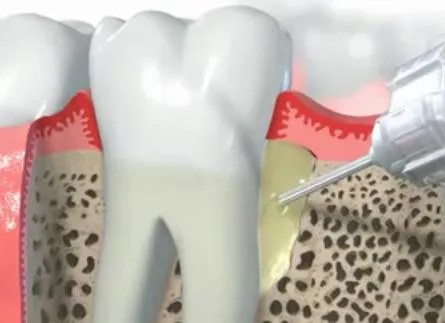
Depending on the shape of the defect, we may use one or more of: a biologic gel applied to the cleaned root surface to support new attachment, bone graft material to fill and support the space, and a protective membrane that keeps gum tissue out while bone heals. We explain which materials are planned for you, and why, before surgery.
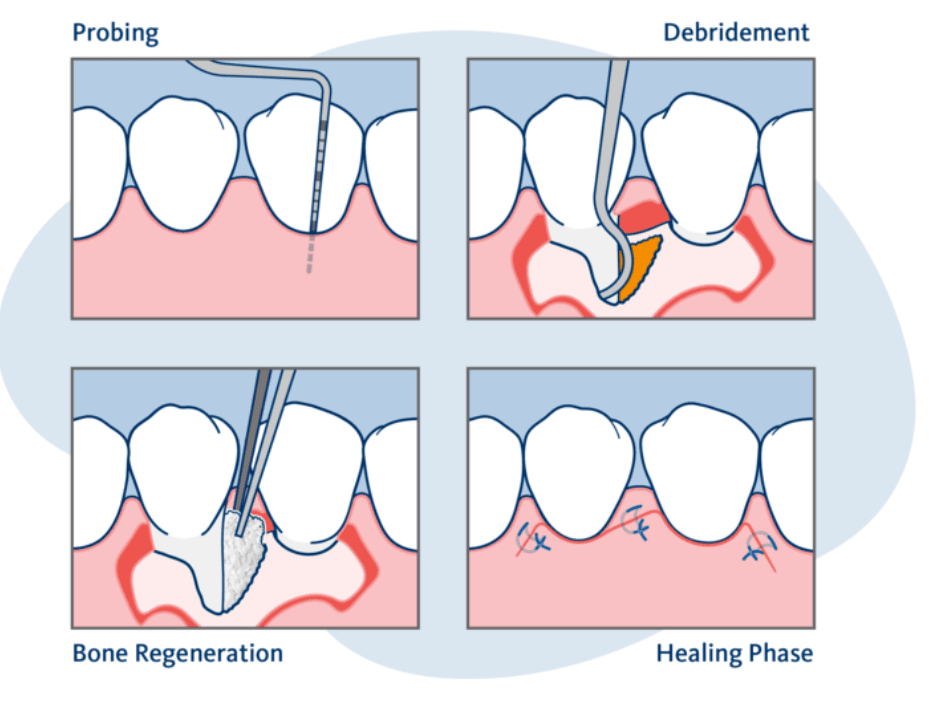
The steps
- 01
Initial gum treatment
Deep cleaning and a review, so surgery starts from healthy, stable gums.
- 02
Planning
X-rays, and a 3D scan where helpful, to map the defect and choose the approach.
- 03
Surgery
Under local anaesthetic, the gum is lifted, the root and defect are thoroughly cleaned, the regenerative materials are placed and the gum is closed with fine stitches.
- 04
Healing
Stitches come out after one to two weeks. New bone matures slowly, so we review with X-rays over the following months.
- 05
Maintenance
Regular supportive care protects the result long term.
Realistic expectations
Regeneration typically rebuilds part, not all, of the lost support. The aims are shallower pockets that are easier to keep clean and a better long-term outlook for the tooth. Results vary between people and sites, and we'll tell you what is realistic for yours.
Common questions
Can it tighten a loose tooth?
Sometimes, if the looseness is due to bone loss that can be partly rebuilt. Looseness can also come from bite forces, which may need managing separately.
Is regeneration better than an implant?
Where a tooth has a reasonable outlook, keeping it is usually preferable. Where it doesn't, an implant may be more predictable. We'll go through both honestly.
I smoke. Can I still have it?
Smoking lowers the chance of success. We'll talk through options, including support to stop before surgery.